

Healthcare Doesn’t Need More Training. It Needs Workforce Enablement.
Health systems are under growing pressure to improve outcomes while navigating workforce shortages, burnout, margin compression, and rising operational complexity. The challenge for most organizations isn’t that they lack strategy. It’s that they lack the capability to turn strategy into sustained behavioral change.
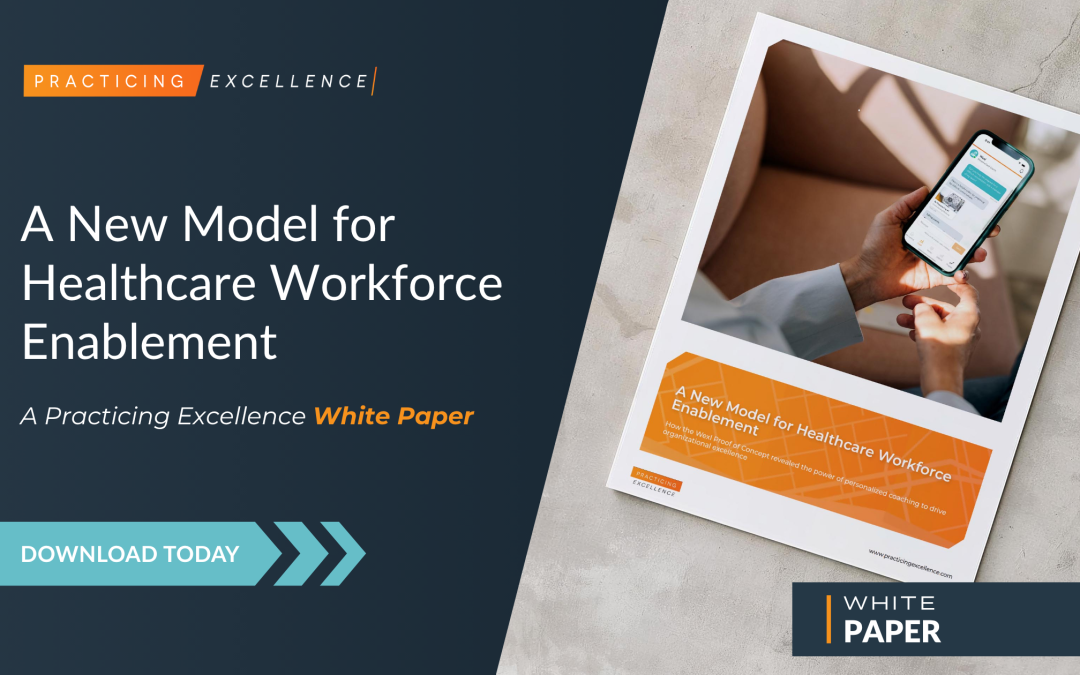
Practicing Excellence’s white paper, A New Model for Healthcare Workforce Enablement, explores how technology-powered, personalized coaching can help healthcare organizations close the gap between knowing and doing.
Why Workforce Enablement Matters Now
Healthcare has reached an inflection point. Nearly 50% of clinicians report burnout symptoms, 41% of nurses plan to leave the profession within two years, and 55% of the broader healthcare workforce plans to look for a new job within the next year.
These challenges carry significant consequences. Nurse turnover costs the average hospital more than $5 million annually, and a single unfilled physician role can cost $1 million in lost revenue.
It’s clear that the need for effective workforce development in healthcare is more pressing than ever. Yet many organizations are still relying on traditional training models that were not designed for the pace, complexity, and emotional intensity of modern healthcare.
Why Traditional Approaches Fall Short
Our white paper identifies a core challenge: health systems struggle to execute the strategies they create.
Traditional learning can expand knowledge, but knowledge alone does not reliably change behavior. Too often, development efforts are episodic, generic, difficult to scale, disconnected from organizational priorities, and removed from the flow of daily work.
A leader preparing for a difficult performance conversation doesn’t need to search through a presentation deck. A clinician preparing to deliver hard news doesn’t have time to attend another class. A manager walking into a tense team huddle requires more than a one-size-fits-all approach.
The missing piece is enablement: continuous, personalized support that helps people apply their learnings in the moments that matter most.
A New Model for Workforce Enablement
1. Workforce development must move closer to the work.
Modern healthcare requires development that is embedded in daily practice. Wexl, Practicing Excellence’s technology-powered “coach in your pocket,” delivers behavioral guidance before, during, and after critical workplace situations without pulling leaders or teams away from their responsibilities.
2. Personalized coaching can help close the execution gap.
In a six-week Workforce Enablement Sprint, 253 clinical and operational leaders across five health systems used Wexl for on-demand coaching on real workplace challenges. Participants used the tool to prepare for conversations, structure meetings, access relevant microlearning videos, and reflect on how their actions led to specific outcomes.
3. Small actions can create meaningful momentum.
Across the sprint, each participant averaged 30 unique interactions with Wexl and generated nearly 1,000 small-scale improvement actions, resulting in more than 70 documented success stories across five health systems.
Nearly 75% of participants reported that Wexl meaningfully supported their growth, and more than 70% said it would be valuable alongside or in place of traditional coaching methods. Leaders described measurable improvements in patient experience, workforce engagement, leadership effectiveness, team collaboration, psychological safety, accountability, and strategic alignment.
4. Technology can help organizations learn from their people.
Wexl doesn’t just help individuals learn; it also helps organizations learn. By capturing patterns from coaching activities, Wexl can surface effective practices, common skill gaps, and improvement opportunities that might otherwise go unnoticed.
What You’ll Learn in the White Paper
Inside the full white paper, you’ll find:
- A deeper look at the market forces reshaping healthcare workforce development
- Why traditional training often fails to translate into practice
- How workforce enablement helps close the execution gap
- Findings from the Wexl Workforce Enablement Sprint
- What the future of healthcare-workforce development can look like
Turning Strategy Into Action
Healthcare organizations don’t need another initiative competing for already scarce time. They need a scalable way to help their people turn strategy into everyday behaviors that improve performance, strengthen teams, and move outcomes forward.
Read the full white paper now to learn how workforce enablement can help your organization bridge the gap between strategy and execution.
Download the full white paper here.

Caroline Anderson is a Content Specialist at Practicing Excellence, specializing in developing and delivering curriculum for the healthcare workforce. She brings a talent for turning complex ideas into practical insights and is passionate about using the power of storytelling to spark meaningful change.


